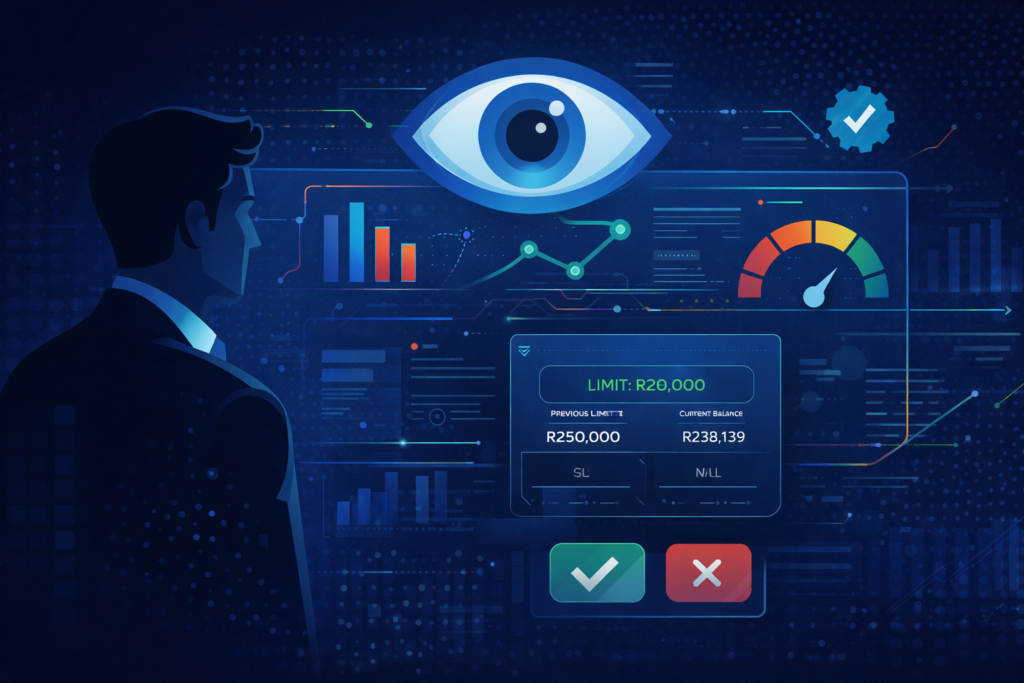
There’s a point where better data stops being about information, and starts changing behaviour.
Up until then, most improvements in credit tend to feel incremental. Slightly faster reports. Slightly more context. Slightly improved processes. Useful, but not transformative.
The shift happens when visibility becomes continuous.
Not just more data, but a clearer, more current view of what’s actually happening across a debtor book at any given moment. Not something you revisit periodically, but something that evolves alongside the businesses you’re trading with.
And when that happens, the role of credit begins to move, almost quietly, into something else.
The most immediate change is in how decisions feel.
When visibility is limited or delayed, decisions tend to carry a certain weight. They rely on assembling pieces of information, interpreting them carefully, and often building in a margin for uncertainty. That’s where caution becomes embedded, not necessarily because it’s always needed, but because it’s difficult to be confident otherwise.
With better visibility, that dynamic softens.
You’re not relying on a single point-in-time view. You’re seeing patterns, movement, consistency. You have a stronger sense of direction, not just position.
And so decisions become less about defending against what might go wrong, and more about responding to what is actually unfolding.
Sometimes that still means saying no. But just as often, it means being able to say yes with more confidence, and more quickly.
Over time, that starts to affect more than just individual decisions.
It begins to change how credit interacts with the rest of the business.
One of the quieter tensions in many organisations sits between finance and commercial teams. Sales is trying to move forward, to close, to grow. Credit is there to ensure that growth is sustainable, but often at the cost of speed or flexibility.
When visibility is limited, that tension is difficult to resolve. Credit has to rely on process. Sales pushes against it. And somewhere in between, decisions slow down.
Better visibility doesn’t remove that tension entirely, but it does change its nature.
Because when both sides are working from a clearer, more current understanding of the customer, the conversation shifts. It becomes less about opposing objectives and more about shared judgement.
And that’s a more productive place to operate from.
There’s also a more subtle shift that happens within the debtor book itself.
When visibility is periodic, attention tends to be uneven. Some customers are reviewed closely, others less so, often based on triggers or timing rather than behaviour.
With continuous visibility, that imbalance starts to level out.
Every customer becomes part of an ongoing picture rather than a snapshot. Changes, whether positive or negative, are easier to detect early. And that allows for smaller, more deliberate adjustments rather than larger, reactive ones.
In practice, that might look like tightening exposure slightly before a problem develops. Or increasing limits where consistency and reliability are clearly visible.
Neither of those actions are new in themselves. What changes is the timing, and the confidence behind them.
What becomes clear, over time, is that better visibility doesn’t just improve risk management.
It changes the quality of decision-making more broadly.
Because risk, in isolation, is only one side of the equation. The other is opportunity. And the two are closely linked.
When you understand risk earlier and more clearly, you’re not only better equipped to avoid loss. You’re also better positioned to recognise where stability exists, where trust has been earned, and where there is space to grow.
That’s the part that often goes unspoken.
Credit has always had the potential to support growth. It just hasn’t always had the visibility required to do so with confidence.
None of this requires a complete redefinition of credit.
The fundamentals remain the same. Judgement still matters. Context still matters. Relationships still matter.
But the environment those decisions sit within can change quite meaningfully.
And when it does, credit starts to feel less like a checkpoint, and more like a continuous input into how the business moves.