There’s a difference between having more credit data and being able to do more with it.
For credit teams, the challenge has never simply been finding information. It’s knowing what that information means, how it changes the picture and when it’s time to act.
That’s where credit intelligence is heading: beyond identifying risk towards understanding what comes next.
At Trade Shield, we’ve been building towards that shift, with developments designed to give credit teams a clearer view of risk and opportunities, backed by predictive insights that help them execute their credit strategy with greater confidence and better results.
Seeing What Your Customer Book Doesn’t Show You
Not every buyer has a long payment history. When data is limited, it can be tempting to take the conservative route.
But conservatism can have a cost too.
Not every buyer has a long payment history. When data is limited, it can be tempting to take the conservative route.
But conservatism can have a cost too.
Our enhanced limit recommendations use richer data to extend scoring across more of your customer book, helping identify where increased exposure may be appropriate and where growth opportunities could otherwise remain hidden.
 As Duane McPherson, Credit Manager at ElectroMechanica, puts it:
“We realised our low bad debt ratio wasn’t necessarily a sign of success. We were being too conservative and missing growth opportunities. Trade Shield’s Grow recommendations helped us identify customers ready for increased credit limits, giving our sales team the confidence to drive growth and increase sales.”
The question is no longer only, “How much risk are we carrying?”
It’s also, “Where are we being more conservative than the data suggests we need to be?”
When Payment Behaviour Isn’t the Whole Story
A buyer’s payment behaviour provides powerful insight into their short-to-medium-term outlook across your debtor book. Financial statements tell you something different: how financially sustainable the business is over the longer term, while also helping to uncover concentration risk among your top customers.
Looking at both gives credit teams a more complete picture.
Trade Shield’s Financial Analysis Reports, powered by Moody’s RiskCalc, provide a structured assessment of a buyer’s financial health. The analysis draws on more than 162,000 sets of annual financial statements from over 51,000 South African private companies and is calibrated against a market-wide annual default rate of 2.8%.
The reports bring together the probability of default, an implied rating, key financial ratios and the financial drivers influencing the assessment.
It means analysts can see not just the outcome, but what is driving it.
Because a credit decision is easier to defend when you can explain the why behind it.
The Information Behind the Decision Matters Too
Sometimes the challenge isn’t having the information. It’s finding it.
Financial statements, applications, sureties and correspondence can end up spread across shared drives, inboxes and individual folders. When someone leaves the business or an audit question lands on your desk, reconstructing the credit file can take time.
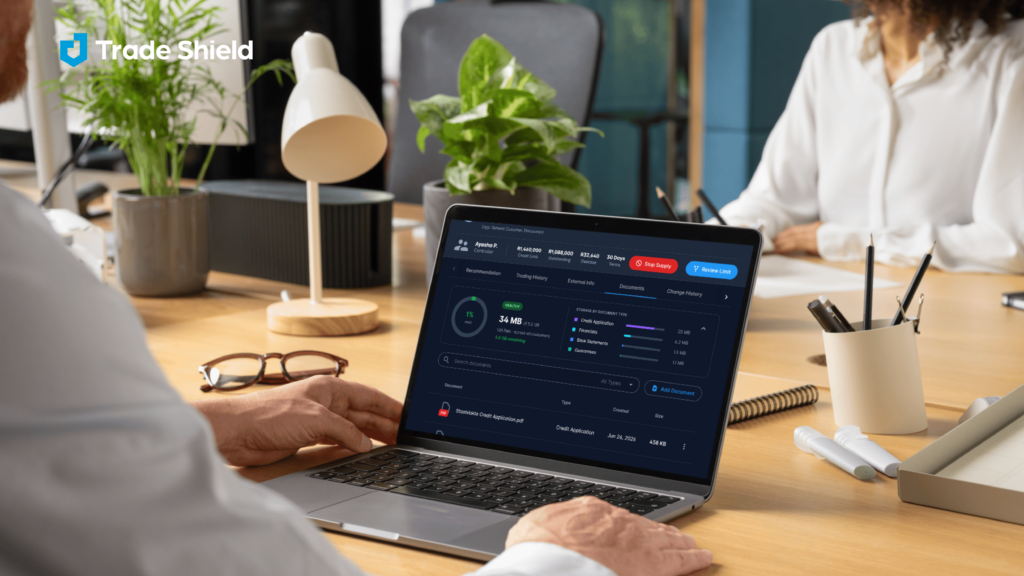
Document Storage brings those documents together on the debtor record, with automatic filing, manual uploads, bulk actions and visibility over storage usage.
The aim is simple: keep the information with the decision it supports.
So when the question comes, the answer isn’t sitting in someone’s inbox.
Looking Beyond Your Own Book
Your customer book tells you what is happening with your customers. But what is happening in the market around them?
That’s the thinking behind the SA Trade Credit Industry Index.
Trade Shield processes a significant portion of B2B trade credit data across the South African market, giving us a broader view of payment behaviour and credit activity than any individual business can see from its own ledger.
The Industry Index brings that broader context into the conversation, showing where industries are strengthening, where pressure is emerging and where opportunities may be developing.
For our clients, that means quarterly benchmarking against peers, helping them identify internal and external shifts faster and with greater accuracy.
Because sometimes the most important signal isn’t inside your own book.
It’s what is happening around it.
And Then There’s AI
The next step is making credit intelligence even more actionable.
AI, and particularly agentic AI, is becoming an important area of focus for Trade Shield. But the opportunity isn’t simply to add AI to existing platforms. It’s about building the safeguards and capabilities into the foundation so that its potential can be leveraged responsibly.
Introducing agentic AI into high-stakes financial processes requires considerable forethought and guardrails. It’s a journey, not a light switch.
We need policy-driven, deterministic recommendations that are defensible and governed by best practice, none of which comes naturally to generative AI. We are exploring how to empower the human-in-the-loop to make better decisions with less effort and in record time, leveraging the power of agentic and generative AI without taking shortcuts or losing control.
 As Marius, Trade Shield’s CTO, explains:
“The opportunity with AI is to help us make better use of the information already available to us. As the pace of business change increases, technology can help us surface more frequent and holistic insights, while shifting where people spend their effort. With agentic AI, our focus is on doing that safely and responsibly, so we can become more effective without increasing the workload on credit teams.”
The goal isn’t to replace credit expertise.
It’s to give credit professionals better signals, better context and more time to focus on the decisions that matter.
From Risk Detection to Foresight
Credit intelligence shouldn’t stop at telling you what has happened.
It should be there when you are making a decision, showing you where you are now, where you are heading and what you can change to get better results.
It should understand your credit policy and company goals, making the actions that move the needle the natural next step, wherever your team is working.
Whether that means identifying a customer ready for more credit, understanding the financial drivers behind a risk assessment, finding the right document when you need it or seeing how your market is changing, Trade Shield is bringing more of that intelligence into one connected view, working towards your broader business objectives.
The future of credit isn’t simply about saying yes or no faster.
It’s about strategically knowing when to protect, when to grow and what to do next.
Trade Shield. Transforming Trade Credit Risk into a source of business growth.